 OFFSCRIPT
Blog · 2026-11-20
Club Website Examples: What Good Football Club Sites Do

Club Website Examples: What Good Football Club Sites Do
The best club websites share one trait: a visitor finds the next fixture, the latest result and the right contact in seconds, and the page is never stale. The examples below show how that looks at different levels, from a village side to a large members’ club. They also show where most clubs fail, which is keeping the site current once the launch excitement fades. That is the problem we built OFFSCRIPT around: a fully managed football club website where the club edits news, squads and match reports in one CMS (content management system, the back-end where you publish) while we handle hosting, maintenance and security.
TL;DR
- A strong club site answers four questions fast: what is the next match, how did we do, who plays for us, and how do I get involved or sponsor.
- The most useful examples are content-first: a latest result, a short match reaction and a fixture list beat a fancy design.
- Research on grassroots clubs links richer features, such as automated results and online transactions, to more value from the website.
- A rebrand works best when you treat it as a project: audit, restructure around what members look for, migrate content, then set up a routine for updates.
- Start at €49 per month (excl. VAT) with OFFSCRIPT, and check your current site first with the free website check.
Table of Contents
- Why a club needs a website when it has social media
- Club website examples worth studying
- What the examples have in common
- Features by club level
- Rebranding a club website: a practical sequence
- What it costs
- Get a site like these, without running it yourself
- FAQ
- Sources
Why a club needs a website when it has social media
Social feeds are quick, but a post disappears down the timeline. A website is the place where the fixture list, squad pages, policies and sponsor information stay put and stay findable, including for people who do not have an account on any platform.
The Gaelic Athletic Association puts it bluntly: a club without a website is like a clubhouse with the doors closed. Its own club sites include live fixtures and results, safeguarding documents and club-branded design, which tells you what a governing body considers the baseline.
For a grassroots club the academic evidence is similar. A peer-reviewed study of small local sporting clubs in the UK and Australia recommends that clubs at least run a simple “brochureware” site with contact details, policies, news and event details. It also found more website adoption and more sophisticated internet use in better-resourced clubs. In other words, the clubs with time and money use their sites more. The aim for everyone else is to remove the need for time.
Club website examples worth studying
Good examples differ in size but follow the same logic: they put what visitors came for in front, and they are updated.
Example 1: a content-first amateur football club
Penistone Church FC is a useful model for a grassroots club. The home page leads with the latest result, followed by match-reaction articles that include a coach’s comment, match highlights and fixture details. Nothing here needs a design budget. It needs someone to post a result and a few lines after each game.
That is the pattern to copy: result first, a short report, then fixtures. It is also exactly the routine that dies when the one volunteer who runs the site gets busy. Our CMS can generate match reports with AI, so a report starts from the match data instead of from a blank page.

Example 2: a members’ club that redesigned around service
The Delaware Athletic Club in the United States documented its redesign in an entry for the CMAA Idea Fair, the club managers’ association showcase. It used member focus groups and behavior analytics to shape the navigation. After launch, user sessions rose 27%, while pages per visit and session length fell. Read correctly, that is a good sign: members got to what they needed faster.
The lesson for a football club is to ask your own people. Ten minutes with parents, players and a sponsor will tell you more about your menu than any template.

Example 3: a site built as a library
The Oaks Club rebuilt its member website as a library of club activity, with meeting minutes, committee notes, newsletters, recorded meetings and project updates in blog form. According to Club + Resort Business, this helped seasonal members catch up on what they missed by email, and cut duplicate copies of the same information.
Amateur football has the same problem. Parents miss the group chat message, a new coach cannot find the safeguarding policy, a sponsor wants last season’s numbers. One place for documents, news and archives saves your volunteers from answering the same question twice.
Example 4: a club that is a ticketed, merchandised brand
Larger and semi-professional clubs add shops, ticketing, a match centre and multiple languages. The GAA’s club sites, for example, include tools such as a match centre and donation features. In our packages these appear as optional modules: an online shop (Shopify or a kit supplier shop), ticketing such as pretix, and a match centre.
You can browse how finished football sites look on our club website projects and demos page.
What the examples have in common
Put the examples side by side and five patterns repeat.
- The match comes first. Latest result and next fixture sit at the top, not behind a menu.
- Every visitor type has a route. Fan, parent, new player, sponsor and journalist should each find their link in one click. A club without these routes loses the sponsor enquiry or the new junior who never asks.
- Content is short and regular. A three-paragraph report after each match beats a monthly essay.
- Documents live on the site. Policies, kit information, training times and contact details are in one place.
- The design carries the club’s identity. Crest, colors and tone are consistent from site to social posts.
The research on small clubs backs the fifth point from another angle. A Deakin University study found that resource-limited clubs which adopted advanced internet features, such as online transactions or automated sporting results, got more value from their websites than clubs without them. Automation is not a luxury for a small club. It is what makes the website pay back.
Features by club level
What you need depends on how many people depend on the site.
| Club level | What the site must do | Typical modules |
|---|---|---|
| Grassroots | Show fixtures, results and contacts; publish simple news; hold policies | Squads, fixtures, news, AI match reports |
| Semi-professional | Add sponsor visibility, member access and social publishing | Sponsor areas, member area, social media kit, match centre |
| Professional | Run commerce, tickets and multiple languages | Shop, ticketing, extra languages, sponsor reporting |
| Any club that is short on time | Keep content current without a volunteer | Content care, automated reports |
Our platform covers news, squads, fixtures, sponsor areas, member access, AI-generated match reports, social media publishing and sponsor reporting, along with hosting, backups, real-time security updates and privacy-compliance tools. Extra teams cost €40 one-off per team, and an extra language is €290 one-off or €19 per month per language.
Sponsors: the site as a sales tool
For many amateur clubs the website is the first thing a local business looks at before it agrees to sponsor. A visible sponsor area, plus reporting on what the sponsor’s placement achieved, gives the club something concrete to show at renewal time. We offer a website sponsor “Presented by …” slot with a ready-made sponsor offer for €149 one-off, and sponsor reporting is part of the platform.
Volunteers: design for the person who will actually maintain it
The typical grassroots site is run by one or two volunteers. When they move on, the site freezes. Plan for that on day one: fewer pages, one login process the committee can pass on, and routine tasks automated. Our content care plans, S at €99 per month and M at €199 per month, exist for clubs that would rather not carry the publishing load at all. And because the club keeps access to all content, data and configuration, a change of volunteers never means losing the site.
Rebranding a club website: a practical sequence
A new crest, new kit sponsor or a merger usually triggers a website rebrand. A site refresh that only changes colors misses the chance to fix structure. Work through it in this order.
- Audit what you have. List every page, then mark which ones visitors actually need: fixtures, squads, contacts, policies, sponsors. Delete or merge the rest. The Oaks Club approach of turning scattered emails into one chronological page is a good model for consolidating updates.
- Ask your audiences. Short conversations with a parent, a player and a sponsor show you what they search for. The DAC redesign used member focus groups before changing navigation.
- Restructure around journeys. Match, join, support, contact. Keep the menu short.
- Move the content. Old match reports, squad histories and photos are part of a club’s memory. We offer a service to move your old website, and content migration is an optional add-on.
- Launch with the domain and data in your hands. At OFFSCRIPT the club owns its domain and data.
- Set the update routine. Decide who posts the result after each game, or let AI-generated reports and content care do it.
Our process page shows the path from enquiry to launch, so you know what to expect at each stage.
What it costs
Budget is the first question for grassroots clubs. Our one-time setup is €490 for Start, €990 for Club and from €2,900 for Pro, and the monthly plans are:
| Plan | Monthly price |
|---|---|
| Start | €49 |
| Club | €129 |
| Pro | €349 |
| Enterprise | €2,490 |
All prices exclude VAT. Optional modules such as an online shop, ticketing (each €390 one-off plus €29 per month) and a match centre (€390 one-off plus €19 per month) are added only when the club needs them. For a full breakdown of what drives the price, read our guide on what a club website costs, and if you are comparing approaches, our article on what a team website builder needs to do goes through the features.
Get a site like these, without running it yourself
The examples above all rest on the same thing: someone keeps the site current. With OFFSCRIPT, the club gets a custom-built site with the Studio CMS, ongoing technical maintenance, hosting, backups and security updates, plus a client portal with live analytics and status. Pricing is fixed, every contract detail is in writing, and you are never locked in.
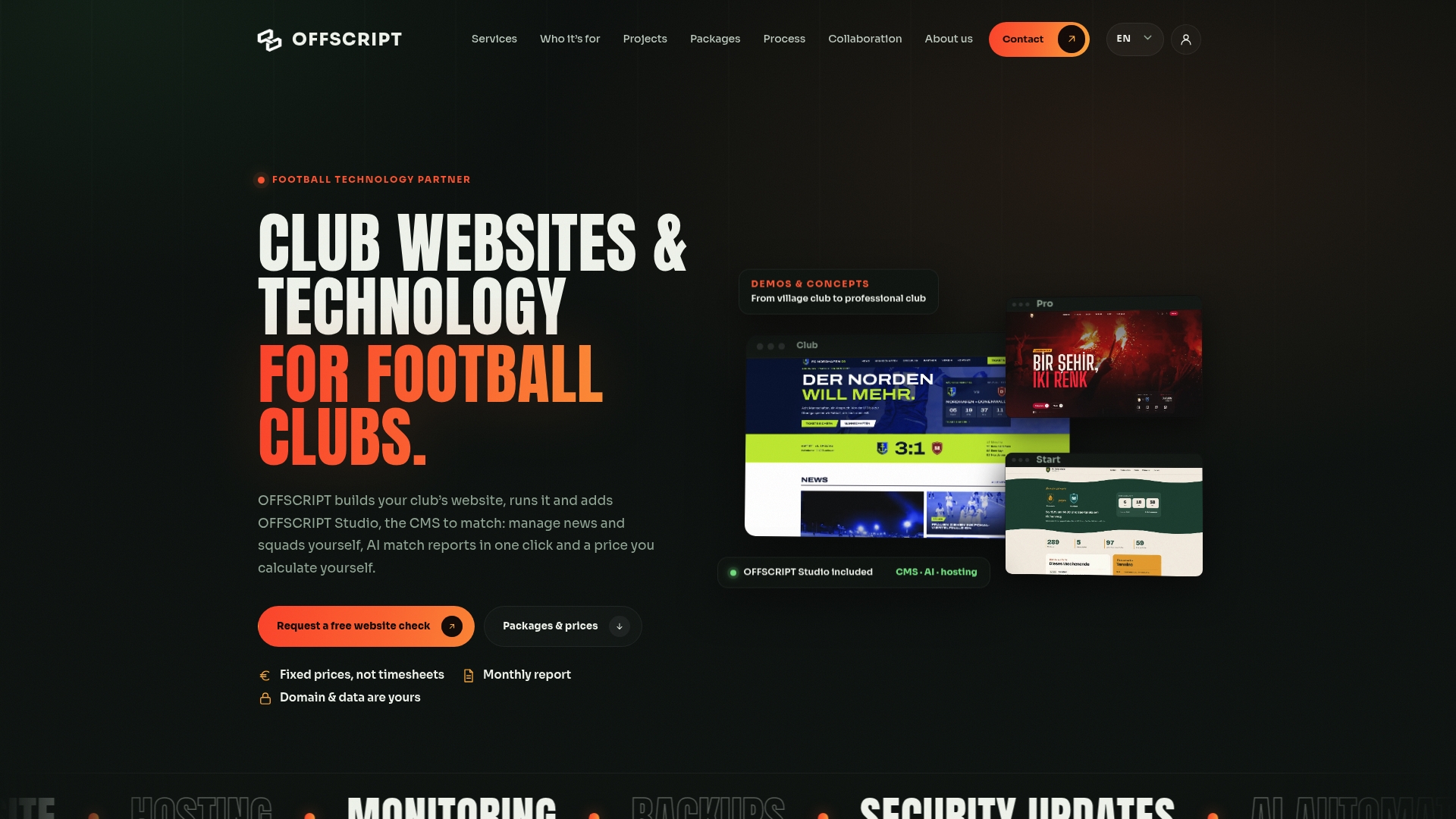
The next step is to run your current site through the free website check, then look at the packages and prices to see which level fits your club.
FAQ
What should a grassroots club website include?
At minimum: contact details, fixtures and results, squad or team pages, news, policies and how to join. The research on small local clubs recommends a simple site with contact details, policies, news and event details as a baseline. Add sponsor visibility and automated results as the club grows.
Is a social media page enough for a club?
It helps, but it does not replace a website. A site keeps fixtures, documents and history in one stable place that anyone can find, and it gives sponsors a professional destination. Governing bodies such as the GAA treat a club website as a basic requirement.
How often should a club update its website?
After every match at least: a result and a short report. Between matches, post squad news, training changes and sponsor features. With AI-generated match reports in the OFFSCRIPT Studio CMS, the report starts from the match data, and the content care plans cover publishing for clubs without a volunteer to do it.
When is the right time to rebrand a club website?
When the crest, name or main sponsor changes, or when volunteers no longer dare to touch the site. Audit the content, restructure around what visitors look for, migrate the archive and set an update routine before launch.
Sources
- Club Websites, GAA
- Home, Penistone Church Football Club
- Website Redesign and Personalization, CMAA Idea Fair
- How The Oaks Club Approached Its Website Redesign, Club + Resort Business
- Mapping the online presence of small local sporting clubs, Journal of the Association for Information Science and Technology
- The value of local sporting clubs’ websites, Deakin University