 OFFSCRIPT
Blog · 2026-11-17
Team Website Builder: What Football Clubs Need in 2026

Team Website Builder: What Football Clubs Need in 2026
A football club does not need a blank canvas and a template. It needs a site that shows fixtures, results, squads and news, and that stays current when the person who set it up gets busy. That is why the best team website builder for a club is a managed one: a site built for football, with a content system your volunteers can use in minutes, and someone else handling hosting, security and maintenance. That is what OFFSCRIPT builds for clubs, from grassroots to professional.
This guide explains what a sports team website builder should include, how the options differ by club level, what the costs are made of, and how to automate the routine work that makes club websites go stale.
TL;DR
-
A club website works when fixtures, results, squads and news are current. Most sites fail on upkeep, not on design.
-
Match the setup to your club: grassroots clubs need low effort, semi-pro clubs need sponsor and member features, professional clubs need shops, ticketing and multi-language support.
-
Cost has three parts: setup, a monthly subscription, and add-ons. Ask for all three in writing, and confirm you own your domain and data.
-
Automation (AI match reports, social publishing, sponsor reporting) saves the most admin time.
-
OFFSCRIPT delivers custom-built, fully managed football club websites with the Studio CMS, hosting, backups and security updates included.
Table of Contents
What a team website builder actually has to do
A “builder” in the general sense is a tool for arranging pages. A team website has a narrower job. Visitors arrive with specific questions: when is the next match, where is it, did we win, who is in the squad, how do I join, who sponsors the club. If the answers are out of date, they stop checking.
For a football club, the core pages are:
-
Home: latest result, next fixture, top news and a clear way to contact the club.
-
Fixtures and results: by team and by season.
-
Squads: players and staff for each side, from first team to youth.
-
News and match reports: the regular content that keeps the site alive.
-
Sponsors: a visible place for the businesses that fund the club.
-
Members area: access to documents, announcements or content for registered members.
-
Club information: history, contacts, how to join, directions to the ground.
Anything beyond that (shop, ticketing, match centre, extra languages) is an extension you add when the club is ready.
The question to ask of any builder or platform is not “how many templates does it have?” but “who keeps these pages current, and how much work is it?”
Why most club websites go out of date
The pattern is familiar. A volunteer builds the site over a few weekends. It looks good at the start of the season. By November the squad page still lists last year’s players, the news section stopped in September, and the login for the hosting account is in someone’s old email.
Three causes show up again and again:
-
One person holds everything. The site depends on a single volunteer’s time, passwords and know-how.
-
Content takes too long. Writing a match report after a Sunday game competes with family, work and the next training session.
-
Technical upkeep is invisible until it breaks. Plugin updates, backups, security patches and hosting renewals are nobody’s job.
A useful platform removes each of these. Content tools should be simple enough for any committee member. Match reports should not start from a blank page. Technical maintenance should be handled by the provider rather than left as a task on someone’s list.
This is the gap OFFSCRIPT was designed to close. Its Studio CMS lets clubs manage news, squads and match reports themselves, with AI-generated match reports to cut the writing time, while OFFSCRIPT handles ongoing maintenance, real-time security updates and hosting.
Choosing by club level
The right setup depends less on the size of the budget than on how much admin time the club really has.
Grassroots clubs: low effort, predictable cost
A grassroots club typically runs on volunteers. Priorities are a clean site that shows fixtures and results, a squad page per team, an easy way to post news, and no surprise bills. A fixed price and a platform that does not need a technical person are worth more here than advanced features.
What to look for:
-
Content editing that works from a phone after a match.
-
AI-assisted match reports, so a report is a few minutes of review rather than half an hour of writing.
-
Hosting, backups and security included in the subscription.
-
Extra teams added one at a time as the club grows. With OFFSCRIPT, an extra team is a one-off £35 per team.
Semi-professional clubs: sponsors, members and more output
Semi-pro clubs publish more and have more to prove to sponsors. They usually need member-only content, a stronger sponsor area and a regular social media presence.
What to look for:
-
A sponsor area and reporting you can send to partners, so sponsors see what their placement delivers.
-
A ready-made way to sell a website sponsorship. OFFSCRIPT offers a website sponsor “Presented by …” placement with a ready-made sponsor offer for a one-off £130.
-
Social media templates in club colors. The OFFSCRIPT social media kit, with Instagram and Facebook templates in the club’s design, is a one-off £255.
-
A match centre for live matchday information. In OFFSCRIPT this is a one-off £345 plus £17 per month.
Professional clubs: a full platform
A professional club needs more than pages. It needs commerce, ticketing, multiple languages, analytics and security that does not depend on a small team.
What to look for:
-
Integration with an online shop, either a Shopify store or a kit supplier’s shop. OFFSCRIPT’s shop integration is £345 one-off plus £26 per month.
-
Ticketing integration (for example with pretix). Also £345 one-off plus £26 per month.
-
Additional languages for international fans: £255 one-off per language plus £17 per month per language.
-
Live analytics and status in a client portal, so the board can see how the site performs without asking a developer.
OFFSCRIPT’s plans run from Start through Club and Pro to Enterprise, so a club can choose the level that matches its needs.
Features worth having, in order of importance
Not every feature is equally valuable. A reasonable order for most clubs:
| Priority | Feature | Why it matters |
|---|---|---|
| 1 | Fixtures, results and squads | The reasons most visitors arrive |
| 2 | Simple content management | Keeps the site updated without a specialist |
| 3 | Hosting, backups, security | Protects the site and the club’s reputation |
| 4 | Mobile-friendly design | Many fans check on their phones on matchday |
| 5 | Sponsor area and reporting | Turns the site into revenue support |
| 6 | Social publishing | Reuses site content on Instagram and Facebook |
| 7 | Shop, ticketing, match centre | Adds revenue and matchday value once the basics run well |
| 8 | Languages | Relevant for clubs with an international audience |
Privacy and youth players
Clubs with youth teams collect and publish information about children: names, photos, sometimes ages and contact details. In the United States, the Children’s Online Privacy Protection Rule governs how online services collect personal information from children under 13, and the FTC published amendments to that rule in the Federal Register in April 2025. Clubs outside the US may fall under other regimes, such as GDPR in Europe, so the rules that apply depend on where your club and members are.
A practical approach for any club:
-
Decide which youth details are published at all, and get consent from parents or guardians for photos and names.
-
Keep registration and member data behind access controls, not on public pages.
-
Use a platform with privacy-compliance tools built in. OFFSCRIPT includes privacy-compliance tools in its websites.
For questions about what your club’s specific obligations are, speak to a lawyer or your national governing body.
What a team website really costs
Cost has three parts, and a fair comparison needs all three:
-
Setup: design and build, content migration, domain configuration.
-
Recurring subscription: hosting, maintenance, CMS access, security, support.
-
Add-ons: extra teams, languages, shop, ticketing, match centre, extra AI actions.
A low headline monthly price can hide a long list of extras, and a one-off build price can hide the cost of the maintenance that follows. Ask every provider for the total for year one and year two, in writing.
OFFSCRIPT’s model is a setup fee plus a recurring monthly subscription for website management, hosting, and the AI and CMS features, with optional add-ons. Prices for the core plans (Start, Club, Pro, Enterprise) are agreed with the club based on what it needs. The published add-on prices are:
| Add-on | One-off | Monthly |
|---|---|---|
| Online shop (Shopify or kit supplier shop) | £345 | £26 |
| Ticketing (e.g. pretix) | £345 | £26 |
| Match centre | £345 | £17 |
| Extra language (per language) | £255 | £17 |
| Extra team (per team) | £35 | none |
| Website sponsor “Presented by …” | £130 | none |
| Social media kit | £255 | none |
| Content care S | none | £87 |
| Content care M | none | £175 |
Moving an existing site is a separate service, and its price is quoted per club.
The pricing is fixed and every service and contract detail is stated in writing, which makes it easier for a club treasurer to budget and for a committee to approve.
Automating the routine work
The biggest saving in club website management is not in the build. It is in the weekly routine. These are the tasks to automate first.
Match reports
A report written from scratch after every fixture is the task most likely to be skipped. With OFFSCRIPT, match reports can be generated with AI inside the Studio CMS. A volunteer reviews, adjusts and publishes, rather than starting from nothing. That turns a chore into a quick check.

Social media publishing
The same news and results that go on the site should reach Instagram and Facebook. OFFSCRIPT includes social media publishing, and the social media kit provides templates in the club’s own design so posts look consistent.
Sponsor reporting
Sponsors renew when they can see what they received. Real-time reporting and analytics, available in the OFFSCRIPT client portal, make it simpler to send partners a clear picture.
Content care
For clubs that want even less on the committee’s plate, OFFSCRIPT offers content care plans at £87 per month (S) and £175 per month (M). They suit clubs that want regular content support alongside the CMS.
Technical maintenance
Hosting, backups and real-time security updates are part of how OFFSCRIPT delivers websites, so nobody on the club side has to remember renewals or install patches.
Questions to ask before you choose
Whether you are comparing a sports-specific platform, a general website builder or a custom-built site, the same questions separate a site that lasts from one that fades:
-
Who owns the domain and the data? The club should. OFFSCRIPT keeps domain and data ownership with the client, and the club retains access to all content, data and configuration, so it is never locked in.
-
Who handles maintenance and security? Make sure it is named in the contract, not assumed.
-
How hard is the content system for a non-technical volunteer? If a new secretary cannot post a result in five minutes, the site will go stale.
-
Is it built for football? Fixtures, squads by team, match reports and sponsor areas should be native features, not workarounds.
-
What happens when you grow? Extra teams, languages, a shop or ticketing should be additions, not a rebuild.
-
Can you see what is happening? A client portal with live analytics and status removes guesswork.
-
Is every price written down? Setup, monthly fees and add-ons, with no hidden extras.
What to prepare before you start
Whichever route you take, the build goes faster when the club has the basics ready:
-
Branding: crest, colors and any style guidelines.
-
Squad and staff lists: names, roles and consented photos for each team.
-
Fixture data: the current season’s schedule, and the source it comes from.
-
Content to carry over: old news, reports and documents worth keeping. OFFSCRIPT offers a service to move your old website so this content is not lost.
-
Sponsor details: logos, links and the agreed placements.
-
Decision on languages, shop and ticketing: know which you need at launch and which can wait.
-
Named owners: a person responsible for content and one for decisions, even if the platform does most of the work.
How OFFSCRIPT fits
OFFSCRIPT builds custom football club websites and runs them for you. The Studio CMS covers news, squads, fixtures, sponsor areas, member access, AI match reports and social publishing. Hosting, backups, real-time security updates and privacy-compliance tools are part of the service. Multi-language options and optional shop, ticketing and matchday modules let the site grow with the club.
The point is to free volunteers and administrators from website upkeep, while the club keeps control of its domain, data and content. Fixed pricing and written terms mean the committee knows what it is signing.
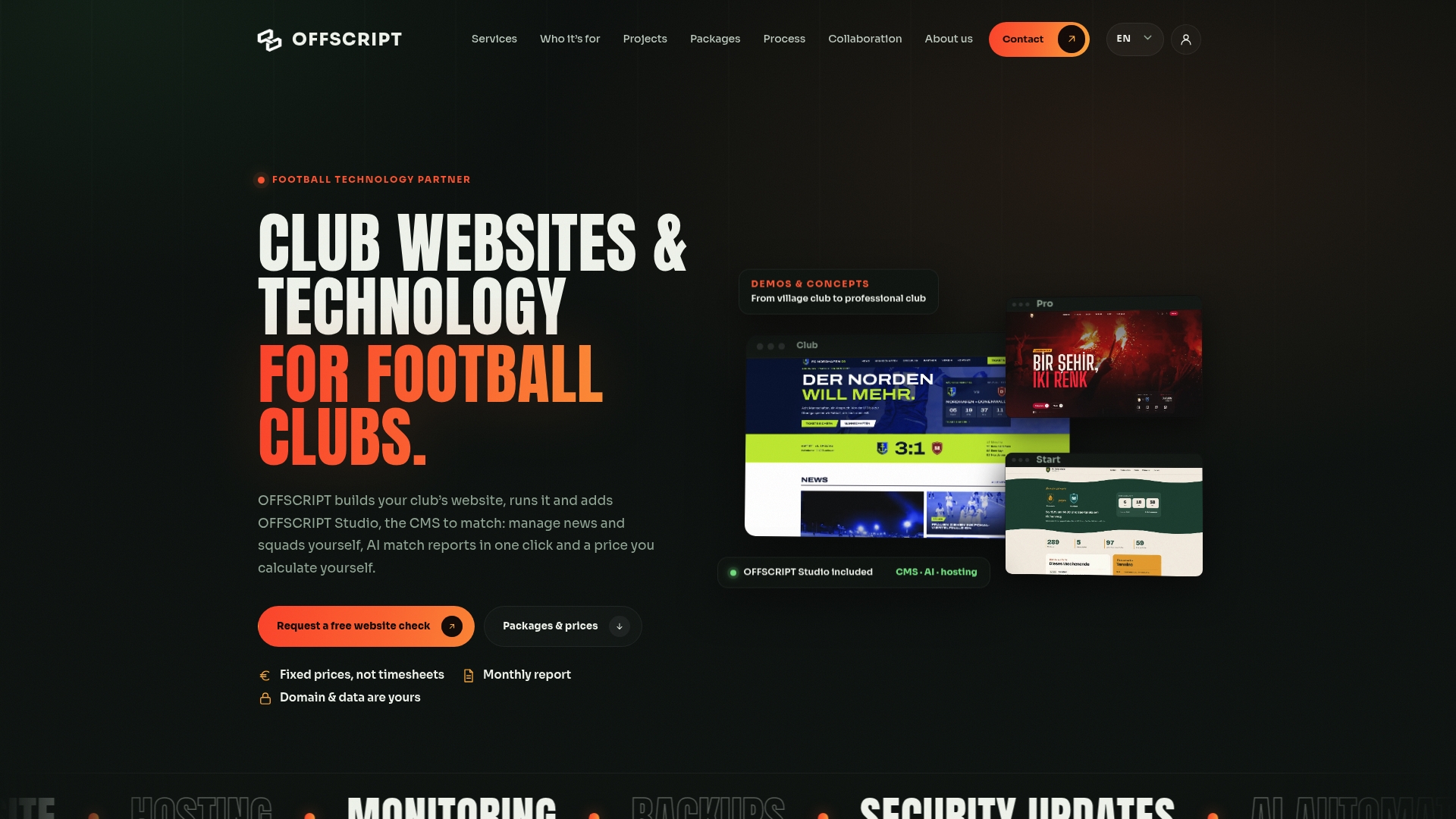
If your club wants a new or relaunched site that stays current without adding to anyone’s workload, you can see the plans and add-ons on the OFFSCRIPT website for football clubs.
FAQ
What is the best team website builder for a football club?
The best choice is one built for football, with fixtures, squads, match reports and sponsor areas included, plus someone responsible for maintenance. OFFSCRIPT provides this as a managed service, so the club edits content in the Studio CMS while hosting, backups and security updates are handled for it.
Can a club without technical skills run its own website?
Yes, if the content system is simple and the technical work is handled for you. In OFFSCRIPT, volunteers manage news, squads and match reports in the Studio CMS, and AI can draft match reports for review before publishing.
How much does a sports team website cost?
It depends on the setup fee, the monthly subscription and any add-ons. OFFSCRIPT’s add-ons are published, for example £35 per extra team or £26 per month for a shop integration, and plan pricing is agreed with the club. Ask for all costs in writing before you sign.
Does the club keep ownership of its website data?
With OFFSCRIPT, yes. The club retains its domain, data, content and configuration, and is never locked in.
What should a club website show about youth teams?
Only what the club has parental consent to publish, and nothing that exposes registration or contact data. Rules differ by country, so check with your governing body or a lawyer about your obligations.