 OFFSCRIPT
Blog · 2026-11-18
Grassroots Football Sponsorship: How to Win and Keep Local Sponsors
Grassroots Football Sponsorship: How to Win and Keep Local Sponsors
Grassroots football sponsorship works when you stop asking a local business for a donation and start offering it a clear, priced package with proof of exposure. Know what you can offer, build three or four tiers, pitch warm contacts first, and report back so sponsors renew. The club website is the asset that ties all of this together, because it is where sponsors get seen and where you show what they got.
This guide is for clubs that need sponsor income without adding hours to a volunteer’s week. It uses “football” throughout. If you run a soccer club in the US, everything applies the same way.
TL;DR
- List every asset you own (kit, boards, website, social, events) before you set a price. Most clubs have more to sell than they think.
- Offer three or four tiers, from a small community package up to a headline partner. Published tiers at US youth clubs run from $250 to $5,000 a year.
- Start with warm introductions from parents, players and committee members, and keep the first message short.
- Put sponsor logos and calls to action where visitors actually go on your site, not only on a hidden sponsor page.
- Report to sponsors during and after the season. Renewals are won on evidence, not goodwill.
Table of Contents
- What a grassroots club can actually offer a sponsor
- Why local businesses say yes
- How to price sponsorship packages
- Sponsorship ideas that go beyond a logo
- How to find and approach sponsors
- Your website is your sponsorship shop window
- Where OFFSCRIPT fits
- Keep sponsors: deliver, report, renew
- FAQ
- Sources
What a grassroots club can actually offer a sponsor
A sponsor is buying visibility and association, and your club probably holds more of both than you assume. The Football Association’s Amateur FA guidance lists brand awareness on kit, websites, at events and venues, e-newsletters and social media, venue hosting and local media coverage. Clubs with links to semi-professional sides can add tickets, hospitality, player appearances or signed merchandise.
Write your inventory down in one list:
- Kit: shirt front (usually the most valuable), shirt back, sleeves, shorts, training wear and bags.
- Ground: pitch-side boards or banners, clubhouse branding, naming rights for a pitch, a stand or a trophy.
- Digital: website placement, newsletter mentions, social media posts and match reports.
- Events: presentation evenings, tournaments, Sponsor’s Days, a sponsor kicking off a match.
- Teams: one age group, one team or the whole junior section.
Be accurate. A small club with a busy social account and a committed junior section can still build a strong offer if it describes what it has honestly, and a fuller list makes it easier to create packages at different price points.
Why local businesses say yes
Price is rarely the only reason. Football Queensland’s club guide names four motives: a personal connection to the club, a wish to belong to its community, a wish to be seen giving back locally, and financial benefit. Hertfordshire FA frames the same idea around three questions: who the potential partners are, what they can offer you, and what you can offer them.
The practical lesson from Football Queensland is that a logo on its own is not enough. Give the sponsor something to say to your audience: a family discount for club members, a free fitting day, a code printed in the match report. A plumber who gets three calls from club parents will renew. A plumber whose logo sits on a sleeve may not.
How to price sponsorship packages
Price from what you deliver, then test against what comparable clubs publish. These are real published figures from youth and grassroots clubs, each for its own year and place:
| Club or document | Entry tier | Mid tiers | Top tier |
|---|---|---|---|
| JIYSC, US youth soccer, 2024 | Bronze $250 | Silver $500, Gold $750 | Platinum $1,000; field naming $3,000 to $5,000 a year |
| White Rock South Surrey Titans, Canada, 2026 | Bronze $500 | Silver $1,000, Gold $1,500 | Platinum $2,000 |
| Buckingham United Soccer Club, US, 2026/27 | Community $500 | Tiers between | Gold $5,000 |
| Kick On with Starling, UK women’s and girls’ team example, 2026 | Kit sponsor £1,000 | Team sponsor £2,000 | Club partner £3,000 |
Two things stand out. Prices climb with what the sponsor receives, and the top tiers cover real costs. In the Kick On example the £3,000 partner covers kit, pitch hire, league fees and equipment, and the £1,000 tier buys a new kit for the season.
A simple tier structure
Most clubs do well with three or four tiers:
- Headline partner: shirt front, the most prominent boards, regular social mentions, a website feature, hospitality at the clubhouse.
- Secondary partner: back of shirt or sleeve, one board, a set number of social posts.
- Community supporter: a single board, a programme or newsletter advert, or one junior age group, priced so a small local shop can say yes.
- Optional extras: a trophy, a presentation night, a field or pitch name.
At Buckingham United, benefits scale across website logo and link, newsletter recognition, from 2 to 12 or more social shout-outs a year, sideline banners, event booth space, jersey logos and naming rights, with multi-year and renewal discounts on offer. That scaling is the model to copy: each step up adds something concrete.
Expect a negotiation. The Amateur FA notes that most deals are negotiated, so the published price and the agreed price can differ. It tells clubs to know their figures before they sit down and not to sell themselves short.
Sponsorship ideas that go beyond a logo
Ideas sell when the sponsor gets to meet your community. Football Queensland suggests:
- Sponsor-named trophies, bar mats, parking sections and ground signage.
- Matchday moments: the sponsor starts the game, runs a marquee or presents the trophies.
- Sponsor visits: boot fitting, a coffee stall, mouth-guard fittings or a car display on the touchline.
- Two Sponsor’s Days per season, so every partner gets at least one live moment.
Add to that a monthly “player of the month presented by” award, a sponsor-named match report series, or a junior-section partner whose name appears on every kids’ fixture page. These cost you almost nothing and give the sponsor repeated, specific exposure.
Sponsorship is not your only income route. Councils and schools may trade pitch access for after-school coaching, and quiz nights, charity matches and raffles sit well beside it, as do grants from football bodies. Treat those as separate work. Sponsors need a professional offer, and that is what this guide covers.
How to find and approach sponsors
Start with people you already know
The Amateur FA advises targeting major local employers, members’ own business contacts, local authorities, health organisations and educational establishments. Your warmest leads sit inside the club: parents who run businesses, players’ employers, committee members’ suppliers. Ask them for an introduction, not a cheque.
Prepare before you call
The Essex Sunday Corinthian Football League’s guide says to prepare an active website and social media, a proposal letter covering who you are and why you need support, different packages, and a formal contract on headed paper with a minimum term. A minimum term makes a sponsor less likely to cancel mid-season.
Make the approach personal
- Ask for the general manager, managing director or a director, not a general inbox.
- Call or visit in person. Random emails risk being treated as spam.
- Engage with the business on social media first.
- Offer a short conversation over a coffee or a meal, with a short pitch rather than a long attachment.
- Personalize every proposal, sell the benefits briefly and precisely, and lead with what the sponsor gets.
A good first message is three sentences: who the club is, how many players, parents and followers it reaches, and an invitation to talk for ten minutes.
Your website is your sponsorship shop window
Sponsors check your website before they say yes, and they look at it again when they decide whether to renew. An outdated page with last season’s squad tells them the club may not deliver. A fresh one with fixtures, results and a visible sponsor area tells them it will.
Football Queensland adds a sharp point about placement: sponsor logos and calls to action belong in the highest-traffic areas of the site, because a dedicated sponsor page on its own attracts few visitors and rarely creates value for the sponsor. Put sponsors on the home page, beside the fixtures and in match reports, with a link and a clear offer.
The website also gives you a product to sell. A club-wide “presented by” placement is simple to explain, simple to price and visible on every page view. Your sponsor page should show your packages, what each includes, and one clear way to respond.
Where OFFSCRIPT fits
We build and run football club websites so sponsorship does not depend on one volunteer finding time to update a page. Each site comes with the OFFSCRIPT Studio CMS for news, squads, fixtures and sponsor areas, AI-generated match reports, social media publishing and sponsor reporting. Hosting, backups and real-time security updates are handled for you, and the club keeps ownership of its domain and data.
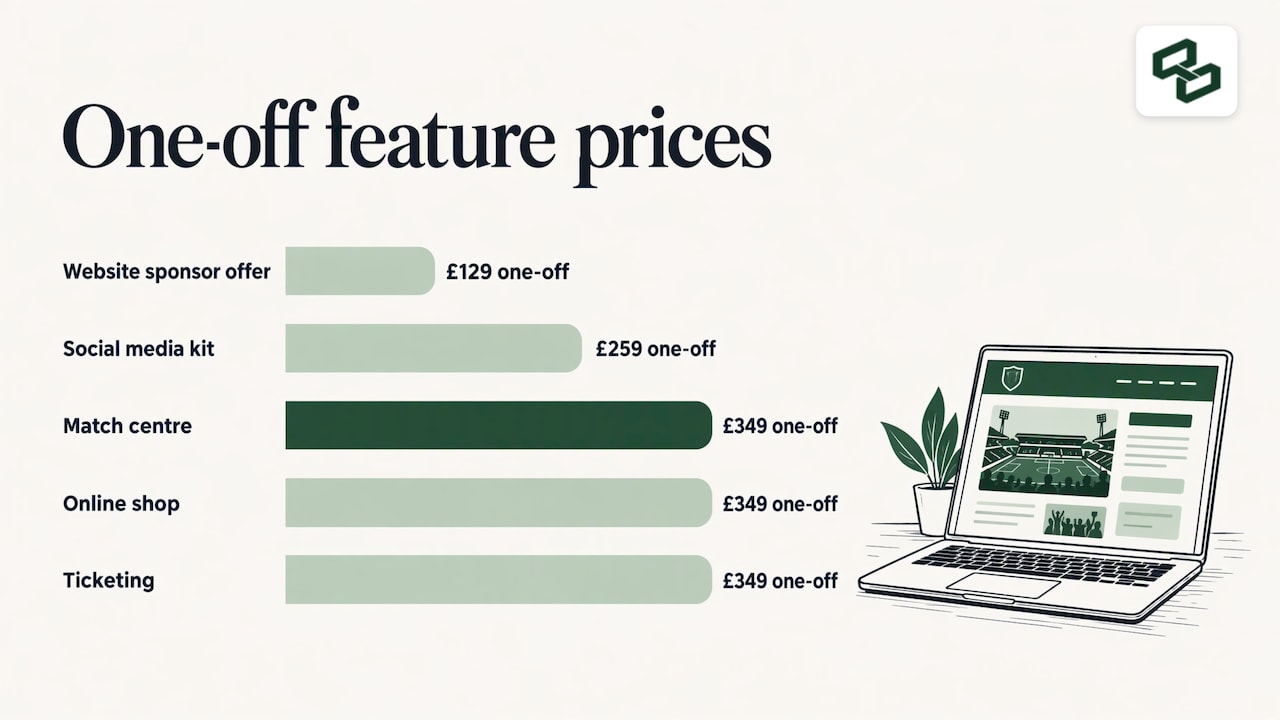
For sponsorship specifically, we offer a website sponsor “Presented by …” with a ready-made sponsor offer at £130 one-off, and a social media kit with Instagram and Facebook templates in your club design at £255 one-off. A match centre is £345 one-off plus £17 per month, a natural home for sponsor placements next to live fixtures and results. If you want us to keep the content fresh, Content care by OFFSCRIPT is £87 per month (S) or £175 per month (M). Plan prices for Start, Club, Pro and Enterprise are set with you. See what fits on the OFFSCRIPT website packages page.
Clubs that need a more complete platform can add an online shop or ticketing, each £345 one-off plus £26 per month, so sponsors can also be seen where fans buy.
Keep sponsors: deliver, report, renew
Most clubs spend all their energy on winning a sponsor and almost none on keeping one. The Amateur FA is clear that after signing you should deliver on every promise, meet or contact sponsors regularly with evidence of their exposure each time, and invite them to club and league events.
AYSO’s best-practices document gives a workable routine for the US:
- Keep packages “simple and executable” so you can honor every item.
- Recruit a sponsorship committee of three to six people so the work is shared.
- Plan over four to six months before the season.
- After the campaign, follow a benefits-execution timeline, invite sponsors to key events, send a recap report with a feedback survey, and schedule a renewal conversation.
The recap report is where a club website pays off. Live analytics and sponsor reporting mean you can show a sponsor how many people saw their placement, rather than telling them it went well. With that in hand the renewal call is short.
A simple yearly calendar helps:
- Pre-season: confirm each sponsor’s benefits in writing and send artwork deadlines.
- Mid-season: a short update with a photo, a social screenshot and visit numbers.
- Sponsor’s Day: one live moment per partner.
- End of season: the recap report and feedback survey.
- Renewal: a conversation with the new offer before the next budget is set.
FAQ
How much does it cost to sponsor a kids sports team?
Published youth packages vary by club and region. JIYSC’s 2024 document lists $250 to $1,000 for its main tiers, and the White Rock South Surrey Titans list $500 to $2,000 for 2026. Field naming and club-wide deals cost more, with JIYSC pricing field naming at $3,000 to $5,000 a year.
How do I get a company to sponsor my team?
Start with warm contacts: parents, players’ employers and committee members’ suppliers. Send a short message, ask for a brief conversation with a decision maker, then present three clear packages and a one-page proposal. Most deals are negotiated, so know your figures first.
What can I offer a sponsor besides a logo on the shirt?
Boards, website and newsletter placement, social media posts, named trophies, matchday moments, Sponsor’s Days and hospitality. Football Queensland also suggests sponsor visits such as boot fitting or a coffee stall, which give the sponsor direct contact with club families.
What should a sponsorship page on a club website include?
Your packages and what each contains, a clear response route, and sponsor logos with links where visitors actually go. Football Queensland advises placing them in the highest-traffic areas of the site rather than relying on a sponsor page alone.
Sources
- Sponsorship, Amateur FA
- Club Support Guide: Sponsorship, Football Queensland
- Sponsorship, Hertfordshire FA
- Help with identifying and approaching potential club sponsors, Essex Sunday Corinthian Football League
- JIYSC Fundraising, 2024
- Titans Sponsorship, 2026
- Buckingham United Soccer Club sponsor page
- Sponsorship Guide, Kick On with Starling, 2026
- AYSO Best Practices for Sponsorship and Fundraising
- How to attract a grassroots football sponsorship, Avec